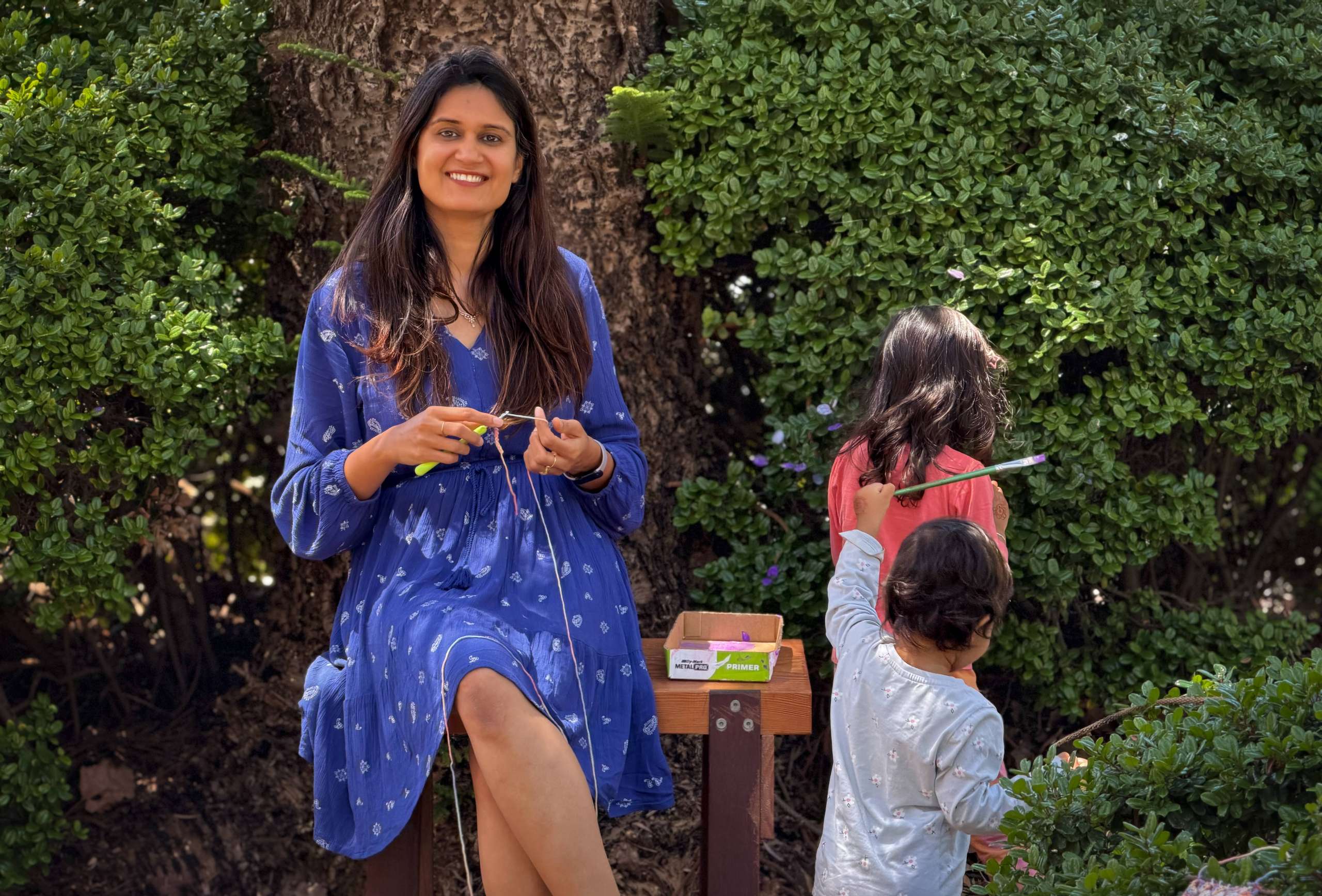
If you happen to stroll along City Beach on a quiet afternoon, you might spot local crochet creative Arushi sitting by the water, cotton thread looped around her fingers and a crochet hook moving in a steady, rhythmic motion.
For Arushi, crocheting by the ocean holds a special nostalgia—it was where she turned for quiet comfort when her husband worked FIFO. Today, whether she is sitting by the sea, waiting in the car between trips, or unwinding after her daughters are asleep, her craft goes wherever she does.
Ask Arushi to sum up what creativity means to her in three words, and she doesn’t hesitate: “Calming, zone out, getaway.”
In a fast-paced world that constantly pushes us to produce more and buy faster, Arushi’s journey with @tangleandtales is a refreshing reminder of why slow, intentional craft matters—not just for the beautiful things we create, but for what the process does for our souls.
Inheriting the Spark: From India to the Australian Coast
Arushi’s creative origins were formed long before she ever picked up a hook. Growing up in India, her childhood was surrounded by women who were always making. Her mother, aunties, and grandmother were constantly crafting, with delicate crochet doilies scattered throughout the family home.
When her family moved back to her grandparents’ house when she was seven, Arushi was formally introduced to more fibre arts. Knitting was taught, but it failed to spark her interest. Crochet, however, was pure magic.
“Crochet was different—I enjoyed it instantly,” Arushi recalls. “One of the very first things I crocheted was a tiny purse for my doll.”
That doll’s purse opened the floodgates to a lifelong love of making clothes, lace, and intricate textiles. While some of her cousins had little interest in picking up the family crafts, Arushi was utterly fascinated. Recognising her spark, the matriarchs of her family passed down their specialised techniques: an aunty taught her tatting (a delicate, durable lace-making technique), while her grandmother introduced her to Sindhi embroidery—a traditional, highly complex mirror-work art.
“My grandma used to do Sindhi embroidery completely without a pattern, which requires so much skill,” Arushi says with admiration. “I have to use patterns because it’s such a tricky technique—one mistake and the whole piece won’t come together.”
That deep appreciation for heritage crafts remains a cornerstone of her life, whether she’s admiring the hand-loomed saris of India or spinning yarn details at local library workshops.
The Math, the Magic, and the Machine-Proof Hook
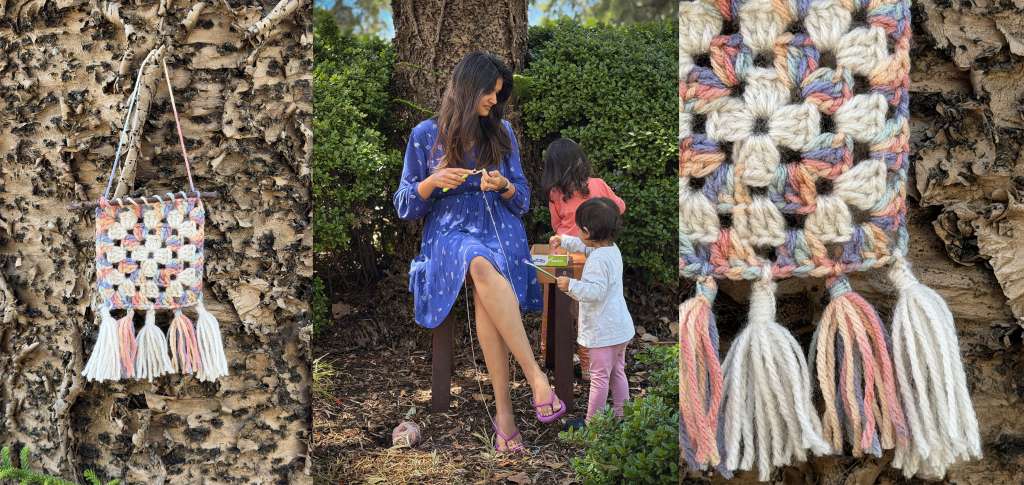
While many people view textile work as purely artistic, Arushi is equally drawn to its structure and logic.
“I love the mathematical side of crochet and embroidery,” she explains. “It is created with a formula, and that formula dictates the exact shape of the final product.”
Preferring fine, crisp cotton thread over wool, Arushi loves pushing herself with ambitious challenges. She has fashioned a complete wearable dress out of granny squares and spent two years hand-crocheting a massive queen-size throw blanket.
In a world of mass manufacturing, non-creatives often ask her why she bothers spending years on a single piece when factories can churn out blankets for a few dollars.
“Friends sometimes joke and say they don’t understand why you would make something when you can just buy it,” Arushi says. “I feel a bit misunderstood there. But machines can’t replicate true crochet. When I look at that throw blanket and realise, ‘I made this with my own hands,’ it gives me such a deeply positive, empowering feeling.”
Stolen Moments: Motherhood, Car Rides & The “Polly Puppy” Emergency
As a mother of two young girls, Arushi’s creative practice has naturally evolved. Gone are the days of endless, uninterrupted hours for two-year blanket projects. Today, her craft is agile, portable, and woven directly into the fabric of daily family life.
“My crochet is always in my bag,” Arushi laughs. “Most of my crocheting gets done in the car while driving around or running errands.”
She squeezes in stitches while her kids play at the library—often making colourful hand-crocheted hair ties—and uses craft as a bridge to connect with her daughters. Lately, she has been teaching them how to make their own traditional Rakhi bracelets.
Motherhood has also sparked unexpected creative adventures. Recently, her daughter fell in love with “Polly Puppy,” a niche character from Bluey, but the toy wasn’t available in any stores.
Her daughter looked at her and said, “Mum, you could crochet one!”
Accepting the challenge, Arushi teamed up with Claude AI to help generate and iterate a 3D amigurumi pattern. Shortly after, she boarded a 4-hour flight to Darwin with her hook and yarn. By the time the plane touched down, Polly Puppy was complete! (Though now, her second daughter has requested her own character—meaning Arushi might need another flight!).
Whether she’s tackling tricky 3D shapes or saving ideas on Pinterest and Instagram to figure out how they’re constructed, Arushi has learned to embrace the natural rhythm of creative work. If a project sits untouched on a shelf for weeks, that’s perfectly fine. For her, creativity doesn’t operate on rigid deadlines—it happens when the time and energy are right.
From Sanctuary to Business: Realising the Value of Her Handiwork
When Arushi first moved to Australia from India, an early breakthrough changed the way she viewed her skills. A local designer hired her to prototype two custom beach towels featuring delicate hand-crocheted borders and corners.
“That was the moment I realised this was a real, sought-after skill that people valued—not just a quiet side hobby,” she reflects.
That realisation eventually led to launching her business, @tangleandtales.
“If you’re good at something, you should be rewarded for it,” she notes.
Yet even as a business owner, Arushi remains a community maker at heart. Crocheting in public spaces like City Beach or local parks often invites curious passersby to stop, ask questions, and admire her work.
“Crocheting in public means people constantly come up to talk to you about what you’re making,” she says. “It opens doors to meeting people in the community you otherwise never would have met. Art creates a genuine connection between people who share a common spark.”
Dream Project: A Hub for Local Makers
When asked what she would build with an unlimited budget and all the time in the world, Arushi’s dream isn’t a massive commercial empire—it’s a sanctuary for her local community.
“I would love to open a local craft café,” she smiles. “A cozy space where craft supplies are accessible just like a library, where people can grab a coffee, pick up some yarn or tools, sit together, and just create.”
Until that café doors open, you can find Arushi sharing her journey, patterns, and finished creations online.
Follow Arushi’s Creative Journey:
Instagram: @tangleandtales